What I do — Conference
A conference where participants set the agenda
No agenda fixed months in advance. Instead, a day that adapts to what is actually alive.
Who is this for?
- You are organising a professional conference or community event for 30–150 people
- You want participants to leave with real connections and concrete insights, not just a full notebook
- You are willing to let go of control over the content and trust the expertise in the room
- You want a format that adapts to what is alive in the group, not what you planned in advance
Coming up
Scrum Event, De Fabrique Utrecht. Two hundred Scrum Masters, Product Owners, Developers and Agile Coaches. A keynote opens the day, the Open Space fills the middle with three rounds of breakout sessions, a live show closes. Facilitated together with the Agile Scrum Group team. Programme
This is the hybrid format at full scale: a fixed opening and closing, with an agenda the room builds itself in between.
Previously facilitated
At these events I was co-organiser and facilitator:
- LeSS conference: Amsterdam, 2025, ~100 participants, the board was full within ten minutes
- XP Days Benelux: 2021, online on QiqoChat, ~100 participants
- Liberating Structures Global Gathering: Brussels, 2025, ~60 participants
- LeanCamp: Brussels, 2017, ~50 participants
Group sizes 20 to 200+. Dutch and English.
What makes Open Space different from a traditional conference?
At a traditional conference, the agenda is fixed. Speakers are booked, time slots are allocated, and participants are audience members. The best conversations always happen in the coffee break.
With Open Space, the coffee break is the programme. Participants propose topics themselves, choose which sessions to attend, and move freely based on where they learn or contribute most. The facilitator holds the process, not the content.
The result: higher engagement, better conversations, and concrete agreements owned by the people who made them.
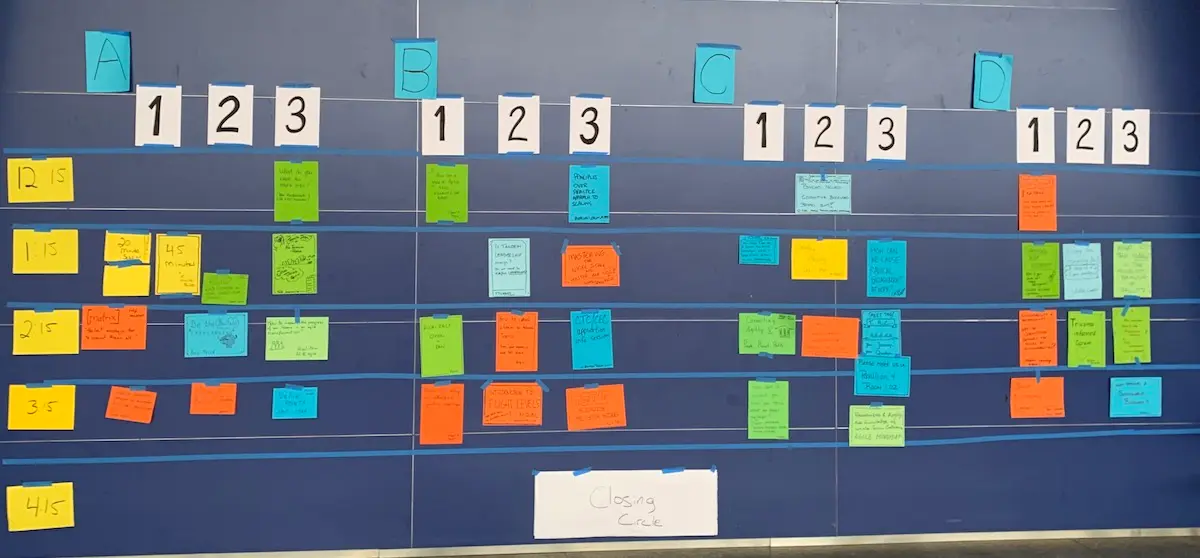
How does a conference day work?
See the approach page for a full anatomy of an Open Space day, from opening to harvesting.
Formats
- Pure Open Space: fully self-organising, one or two days
- Hybrid format: keynote or opening, then Open Space.
- Liberating Structures within sessions: activating microstructures such as Impromptu Networking as an opener or connector between blocks
Not sure whether Open Space fits your event? See the choosing guide.
From day to agreement
An Open Space produces a harvest: everything participants wrote down themselves. A report is not yet a decision, and that is where large gatherings usually stall. That is why I discuss this with the client during preparation: who decides after the day, how, and by when. Groups that work with consent already have that form in place.
If the form itself does not fit, read when I advise against Open Space.
More on the preparation: the invitation is the design.
Frequently asked questions
What is an unconference?
An unconference is a conference where participants set the agenda themselves, rather than following a pre-determined programme with invited speakers. Open Space Technology is the most widely used format for unconferences. Participants propose topics at the start of the day, choose which sessions to attend, and move freely based on interest. Well-known examples include BarCamp, LeanCamp and Open Space conferences.
How large does a group need to be for an Open Space conference?
An Open Space conference works best with groups of 30 to 150 participants, though groups of 20 to 500+ are also possible. The minimum is around 15–20 people, since parallel sessions require sufficient participants. The LeSS conference in Amsterdam had ~100 participants, the LeanCamp edition in Brussels ~50.
What does Open Space facilitation cost?
I work with a day rate plus the preparation the challenge requires. With Open Space that preparation carries weight: the central question, the participant group, and the agreement about what happens after the day determine whether it works. Total cost depends on group size, number of days, venue and follow-up. You receive a quote after the thirty-minute exploratory conversation.
Can Open Space work online?
Yes, Open Space Technology works online. With video conferencing (Zoom or Teams) using breakout rooms and a digital whiteboard (Miro) as the marketplace, a full Open Space experience is possible online. The dynamic is different from in-person, but the core principle (participants set the agenda themselves) remains fully intact.