How an Open Space day works
The anatomy of a day
An Open Space engagement has three phases: preparation, the day itself, and what continues afterwards. The day is the visible moment, not the whole engagement. Below are the five steps, from invitation to follow-up.
An Open Space day has a fixed structure, but no fixed programme. The structure creates the space. What happens within that space is determined by the participants themselves.
More about the method: What is Open Space Technology?
Preparation (weeks before the day)
Together with the client, I formulate a question participants want to answer: the invitation that sets the day in motion. I also determine the participant group, the logistics, and the harvesting strategy: how are the day's outcomes translated into concrete next steps?
More on why the invitation is the design: the invitation is the design.
Opening & the marketplace
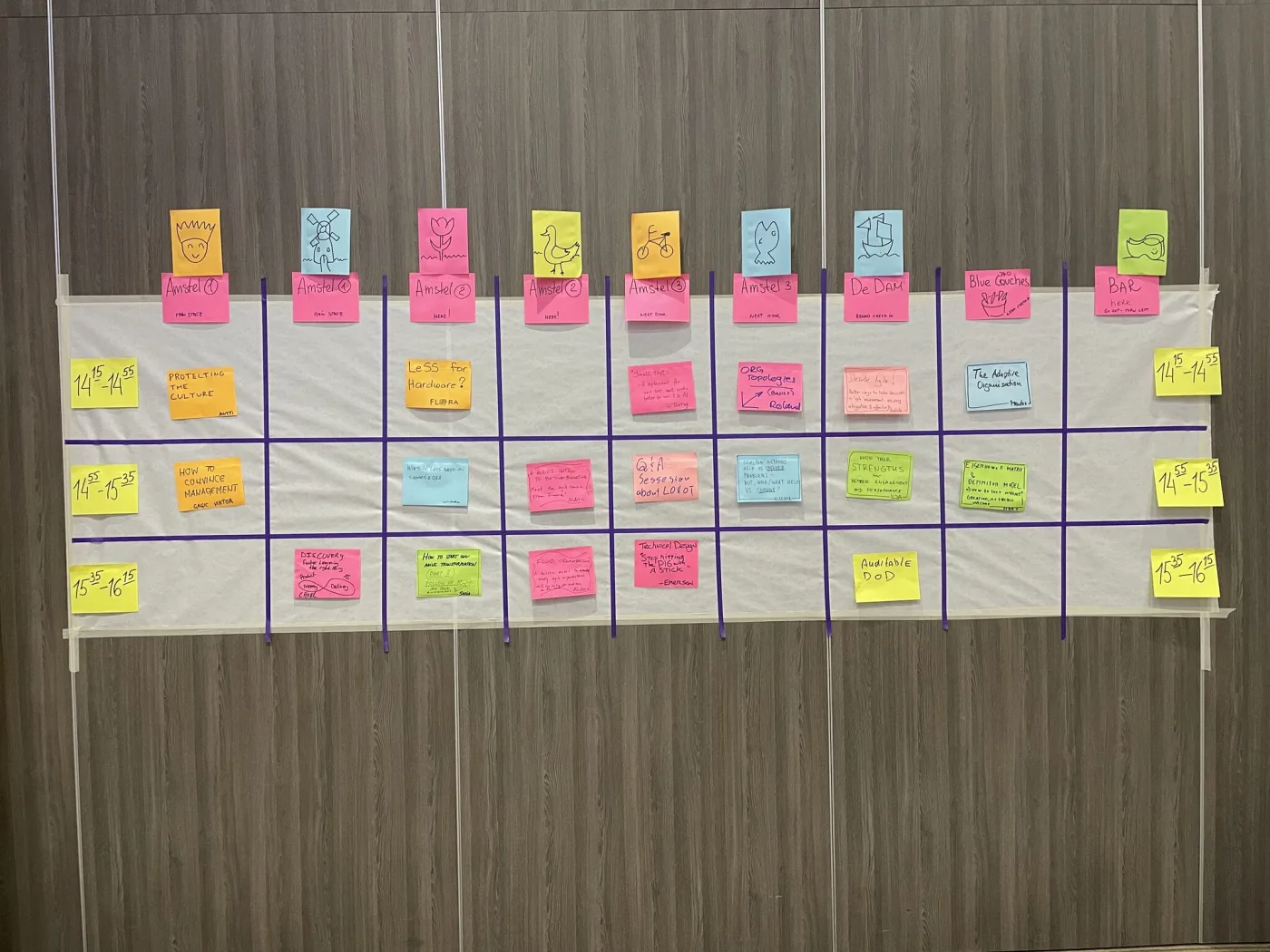
The day begins in a large circle. The facilitator explains the process and invites participants to propose topics they want to discuss. Anyone with a question, idea or challenge writes it down and announces it to the group. This creates the marketplace: an agenda made entirely by the participants themselves.
The sessions
Participants choose which sessions to attend based on their interest and expertise. The Law of Mobility applies: if a session is no longer relevant, move to another. That is the engine of the process. Whoever proposed the session records the outcomes.
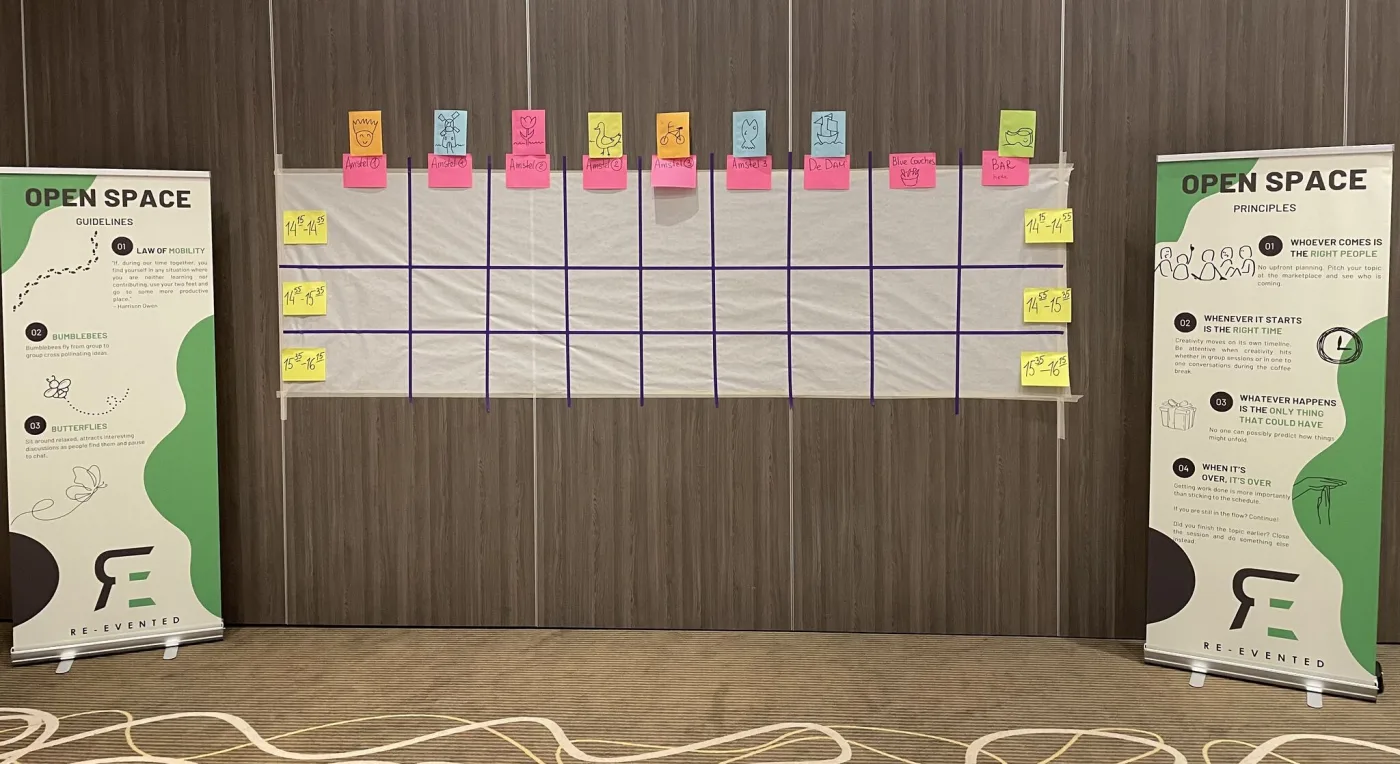
The time slots on the board set the rhythm of the day. At the end of a block I sound a gong. That is information rather than an instruction: the slot as announced is over, and whether the conversation continues is for the participants to decide.
The reverse also holds: nobody has to fill a slot. If the work is done after twenty minutes, break up. I encourage it. Participants also move or merge sessions themselves. The room has one hard closing time, and that is the only moment when the clock counts.
Harvesting
At the end of the day, the outcomes of all sessions are shared with the whole group. Depending on the objective, the group prioritises, creates action plans, or determines next steps. The harvest is what the participants themselves created.
What that harvest actually produces varies: what an Open Space actually produces.
Closing & follow-up
The day closes in the large circle, with space for reflection. After the day, the client receives a summary of all session outcomes. I often also schedule a follow-up session to sustain the energy and agreements from the day: the same cluster-prioritise-celebrate pattern I have used over ten years of facilitation, across roughly a hundred retrospectives and working sessions.
What you need
The requirements for an Open Space are surprisingly simple:
- A large space where all participants can sit in a circle for the opening and closing
- Smaller spaces or corners for the parallel sessions
- A marketplace wall: a large wall surface or flip charts for the agenda
- Paper and markers for session proposals and notes
- Coffee, tea and space for informal conversation: continuous throughout the entire programme, no separate breaks
Open Space works online when participants can move between sessions on their own. Standard Zoom can do that with self-selection for breakout rooms, with a Miro board or Google Doc as the marketplace. What that requires in practice: what an online Open Space needs.
Not sure whether this form fits your challenge? See when I advise against Open Space.